


Try to Remember

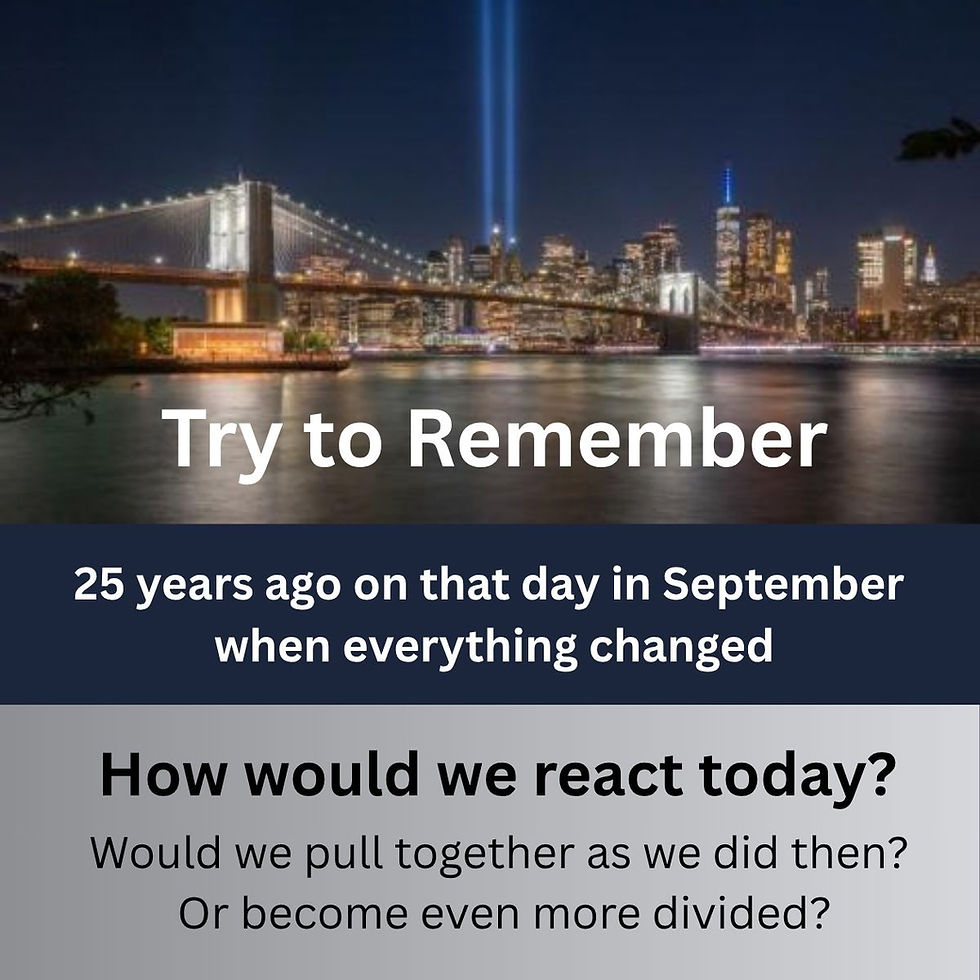
It’s hard to believe that 9/11 happened 25 years ago—and even harder to realize that 40% of Americans (i.e., those 30 and under) have little or no direct memory of what happened on that fateful day and the difficult days, months and years that followed.
9/11 was a classic Black Swan event. Whether we should have seen it coming or not, we didn’t. The impact was horrific, visceral and unbelievable on so many levels. Everything changed, and no one knew what was coming next or how We the People and our political leaders would react.
9/11 happened less than a year after President George W. Bush had taken office in a contested race against Al Gore, where Bush failed to win the popular vote and a Supreme Court decision effectively stopped a recount, giving Bush the victory. Democrats were furious. The House and the Senate were closely divided.
But in the best American tradition, we pulled together as a nation. As Gerald Seib said in The Wall Street Journal this week, “In a Wall Street Journal poll taken at the time, 82% said they approved of the job being done by President [Bush]... Almost three-quarters of Americans said that despite the attacks—or maybe because of the united response to them—the country was on the right track. In many ways, America was at its best.”
How would we react today if we were faced with a comparable Black Swan event? Would we pull together, or blame everything on Trump or the Democrats and be unable or unwilling to act?
In my first novel, Intentional Consequences, a political thriller I released in 2019, one of the characters, Rakesh Jain, says, “I worry about the potential impact of a Black Swan event... I don’t know how we’ll find national consensus in an economic or wartime emergency if the American public can’t decide who to believe or what the facts are. Trump calls everything he disagrees with ‘fake news’. The Democrats and much of the media are doing everything they can to destroy the President’s credibility, both to make it hard for him to govern and to defeat him in the next election. If America gets into a crisis and the public doesn’t believe their president, who will they believe? And how will we decide?”
His wife responds, “It’s easy to blame Trump for his role in undermining presidential credibility and creating confusion about American foreign policy, but the Democrats and the liberal media are far from innocent beneficiaries. They know exactly what they’re doing. I’m not sure whether they fail to appreciate the unintended consequences that could follow, or they just don’t care about the results.”
Rakesh says, “Maybe they think any price is worth paying to get the revenge they want.”
That was seven years ago. Let’s hope we don’t have to find out.


Comments